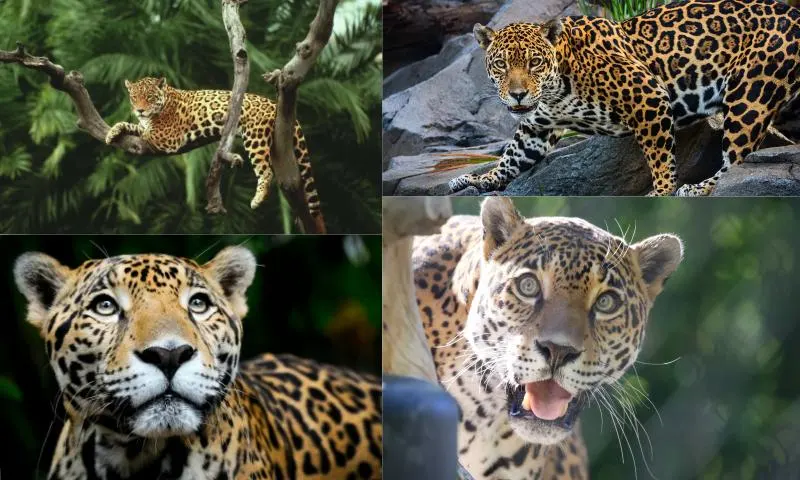
The jaguar (Panthera onca) is one of the largest members of the cat family and is the largest wild cat living in the Americas. This impressive animal draws attention with its powerful build and unique spotted pattern. Its rarity in the wild and agility make the jaguar a mysterious and awe-inspiring creature. It is most commonly found in the tropical forests of Central and South America, especially in the Amazon region. Jaguars' short yet muscular body structure makes them powerful hunters. Their weight usually ranges from 45-100 kg; some males can exceed 120 kg. Their short legs are not ideal for long-distance running but for sudden leaps and powerful claw strikes. One of their most striking features is that they are one of the land cats with the strongest jaw structure in nature. Their jaws are so powerful that they can even break a turtle's shell. For information on this topic and to ask your questions, you can look at relevant online companies on web pages and examine them in detail from here.
Hunting Style and Habitat
Jaguars are solitary animals that usually hunt at night. They are patient and intelligent when it comes to hunting. They typically ambush their prey and catch them with a sudden strike. Unlike other big cats that suffocate their prey, jaguars usually target the brain by biting directly into the skull. This method allows them to neutralize their prey quickly. They are quite diverse in their diet; they can hunt land animals such as deer, pigs, and capybaras, as well as fish, caimans, and even anacondas. Jaguars are also excellent swimmers. They enjoy hunting near water and move comfortably in lakes and rivers. Jaguars' habitats include forests, swamps, and riverbanks. However, due to deforestation and human activities, their natural habitats are shrinking day by day. This has led to a decrease in the jaguar population.
An Endangered Legend
The jaguar also holds cultural significance as a symbol in some regions. Ancient Mayans and Aztecs viewed the jaguar as a divine power and associated it with the warrior spirit. Although this admiration continues today, jaguars are under serious threat. The International Union for Conservation of Nature (IUCN) classifies the jaguar as a "vulnerable species." The biggest threats are habitat loss, illegal hunting, and human-wildlife conflicts. The destruction of rainforests, especially for agriculture and mining, has severely reduced jaguar habitats. Furthermore, illegal trade for their pelts and teeth remains a problem. As part of conservation efforts, jaguars are legally protected in many countries. Efforts are being made to prevent the extinction of jaguars through the protection of their natural habitats, the reduction of human-wildlife conflicts, and awareness campaigns. The jaguar is a species that represents both the graceful and predatory face of nature. Its survival is of great importance not only for the ecosystem but also for the continuity of the bond between humanity and nature.